



Running on Empty: Stress, Burnout and How to Find Your Way Back
Overthinking, sleepless nights and a body that starts to show the strain: what stress and burnout really are, what helps, and how to find your way back slowly.
By Janice F. · 8 min read
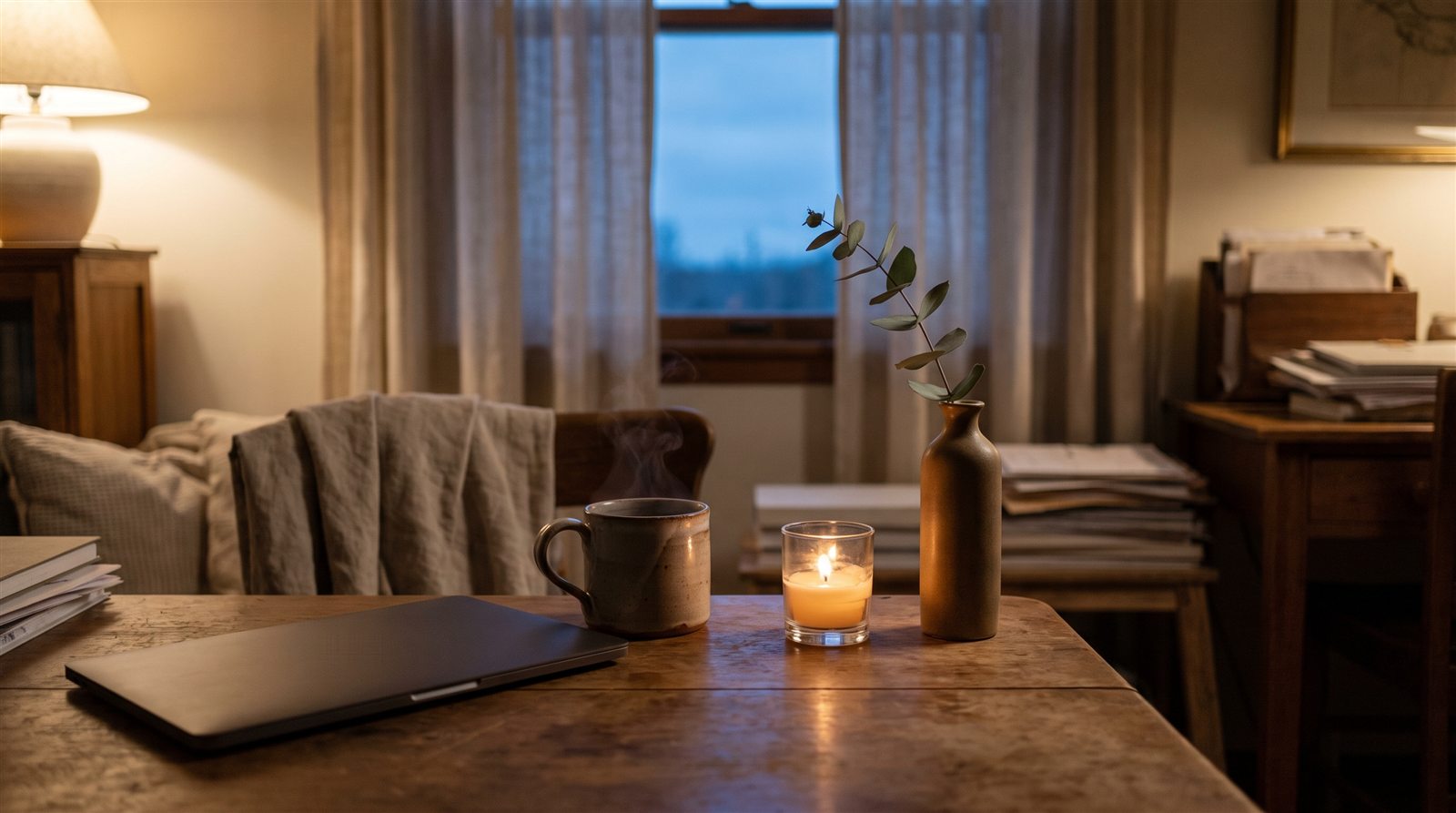
It is late, and I am still awake.
The house has gone quiet, but my mind has not. It is running ahead to tomorrow, to next month, to a future that has not happened yet, rehearsing every way it could go wrong. And when it gets tired of the future, it turns around and walks back into the past, replaying things that are already over. Things I cannot change. Things I was never in control of to begin with.
As a woman, I think I have always done this. I overthink. I worry about everyone and everything, and then I worry about how much I worry.
Do you do the same?
It follows me into the day, too. Sometimes I am in the middle of a conversation, nodding, smiling, and part of me has already slipped away, wandering through some small unnecessary thought about me, about what might happen, about what I should have said. I am there, and I am not there.
The strange part is that I know. I know I am stressing myself over things I cannot fix. I know I am not supposed to carry them like this. Knowing has never been enough to make it stop.
When the body speaks first
My body noticed before I was ready to admit anything.
There came a point when I started losing hair. Then my scalp, of all places, began to flake with dandruff. Small things, maybe. But they felt like a message: whatever you are carrying, it has gone further than your thoughts.
I later learned I wasn't imagining the connection. The NHS lists stress as one of the causes of temporary hair loss, and most hair lost this way grows back once the cause settles [6]. Patient guidance on seborrhoeic dermatitis, the skin condition behind dandruff, notes that emotional stress is thought to make it worse [7]. If hair loss worries you or is affecting how you feel, the NHS says to see a doctor [6].
That is the thing about stress. The World Health Organization says it affects both the mind and the body [1]. It can show up as headaches, aching muscles, an upset stomach, a racing heart, trouble sleeping, changes in appetite, difficulty concentrating, constant worry, a short temper, or leaning more on alcohol, cigarettes or other substances [1][3]. The US National Institute for Occupational Safety and Health describes job stress as the harmful physical and emotional responses that happen when what is asked of you doesn't match what you have, and warns it can raise the risk of health problems over time [4].
One honest warning: chest pain can also mean a heart problem. If you have chest pain, especially with breathlessness or pain spreading to your arm, jaw or back, get emergency help straight away.
Stress, and what comes after it
The WHO describes stress as a state of worry or mental tension caused by a difficult situation [1]. On its own, that is human. A little of it can even help us rise to a challenge.
Burnout is what can happen when that pressure never lets up. The WHO defines it as a syndrome that comes from chronic workplace stress that hasn't been successfully managed, and names three signs [2]: feeling drained or exhausted, feeling mentally distant or cynical about your work, and feeling less effective than you used to be.
The WHO is careful to say that burnout belongs to the world of work [2]. But many of us know that the same kind of empty can build up anywhere: in a home, in caring for others, in a mind that will not stop running at night. Whatever we call it, it deserves to be taken seriously.
Overthinking is the mind trying to protect us from a future it cannot see. It just forgets to let us rest.
The myth of the strong one
Many of us were raised to be the strong one. The eldest. The one who copes. So we keep going long after we should have stopped, and we tell everyone we are fine.
Being strong was never meant to mean carrying everything alone. The WHO says that if we are finding it hard to cope with stress, we should seek help, especially when it has become persistent and is affecting daily life, because ongoing stress can lead to anxiety or depression that need proper care [1]. The NHS suggests seeing a doctor if you're struggling, or if what you're trying on your own isn't helping [3].
If you ever feel unsafe, or have thoughts of harming yourself, contact your local emergency services or a crisis line right away. You are worth that call.
What I am doing now
I don't have this solved. But I am learning, one small habit at a time.
I write my thoughts down. All of them, the big fears and the silly ones. On paper they stop circling. They sit still long enough for me to look at them, and most of them turn out smaller than they felt in the dark.
I listen to music. Sometimes it is the songs of the nineties, the ones I grew up with. A few minutes of a familiar song and my shoulders drop, my breathing slows, and for a little while I am somewhere lighter.
And every day I try to release a little of the stress. Not all at once. Not immediately. Slowly. I am learning that slowly still counts.
What helps, according to the experts
If you need a place to begin, this is what the WHO and NHS recommend [1][3][5], in my own words:
Keep a simple rhythm to your days, meals, rest, a little movement, time with people you love, because routine gives back a sense of control. Protect your sleep like it's medicine: regular times, a dark room, fewer screens and less caffeine at night. Walk, even for ten minutes; it won't solve the problem, but it clears your head enough to face it. Tell someone you trust the truth. Focus on the things you can actually control, and try to accept the ones you can't. Do the most important thing first and let go of doing everything. Set small targets you can reach. Find a little time that belongs only to you. Breathe slowly when the tension climbs. Go easy on the quick fixes, the extra coffee, the drink, the cigarette, because they borrow calm from tomorrow. And at the end of each day, write down three things that went well, however small.
If work is the main weight, it can help to speak honestly with a manager, HR or an employee support programme about your workload or flexibility. Burnout is often a problem with the situation, not with the person.
Saying it out loud
For those of us who overthink, the hardest thing is often to say the simplest sentence: "I'm not okay, and I can't carry this alone."
If you have a partner, they deserve to hear it, and you deserve their help. Choose a calm moment, not the end of a terrible day. Then try:
"My mind won't switch off. I'm lying awake worrying about things I can't control, and it's starting to affect my body."
"This isn't about you. I just don't have much left to give right now."
"Can you sit with me for ten minutes before bed, so I'm not alone with my thoughts?" Or: "Can you take bedtime a few nights this week, so I can rest?"
Plan one small change together, an earlier night, an evening off, a task handed over, and check in after a week.
And to the partner reading this: believe them, even if they seem to be coping. Stress often hides behind "I'm fine." Listen before you fix. Take something off their plate without being asked. Guard their rest. Encourage them to see a doctor if things don't improve, and offer to go along.
Permission
To the woman lying awake tonight, replaying yesterday and rehearsing tomorrow: you are allowed to put it down.
You cannot pour from an empty cup, and you were never meant to carry everything alone. Write one worry on paper. Play one song you love. Keep one evening only for rest. It is not giving up. It is how you find your way back, slowly, one small day at a time.
Sources
- [1] World Health Organization. "Stress" (questions and answers). who.int/news-room/questions-and-answers/item/stress
- [2] World Health Organization. "Burn-out an 'occupational phenomenon': International Classification of Diseases." who.int/news/item/28-05-2019-burn-out-an-occupational-phenomenon-international-classification-of-diseases
- [3] NHS. "Stress." nhs.uk/mental-health/feelings-symptoms-behaviours/feelings-and-symptoms/stress
- [4] National Institute for Occupational Safety and Health (CDC). "Stress... at Work." cdc.gov/niosh/docs/99-101
- [5] NHS. "10 stress busters." nhs.uk/mental-health/self-help/guides-tools-and-activities/tips-to-reduce-stress
- [6] NHS. "Hair loss." nhs.uk/conditions/hair-loss
- [7] Patient.info. "Seborrhoeic dermatitis" (peer-reviewed patient leaflet). patient.info/skin-conditions/seborrhoeic-dermatitis-leaflet
This article is for general awareness and reflection. It is not medical advice or a diagnosis. If stress is affecting your health or daily life, please talk to a doctor or a mental health professional. In a crisis, contact your local emergency services; the support contacts in Settings are there for you too.
What is one thing draining your energy right now, and one small thing that gives some back?
Write as much or as little as you like. It stays private on this device.
Write your own