



Side A, Side B: Music, Mood and the Songs That Bring Us Back
A mixtape in words: what research says about music and stress, why the songs of our youth hold on so tightly, and how to build a playlist that helps you come back down.
By Janice F. · 5 min read
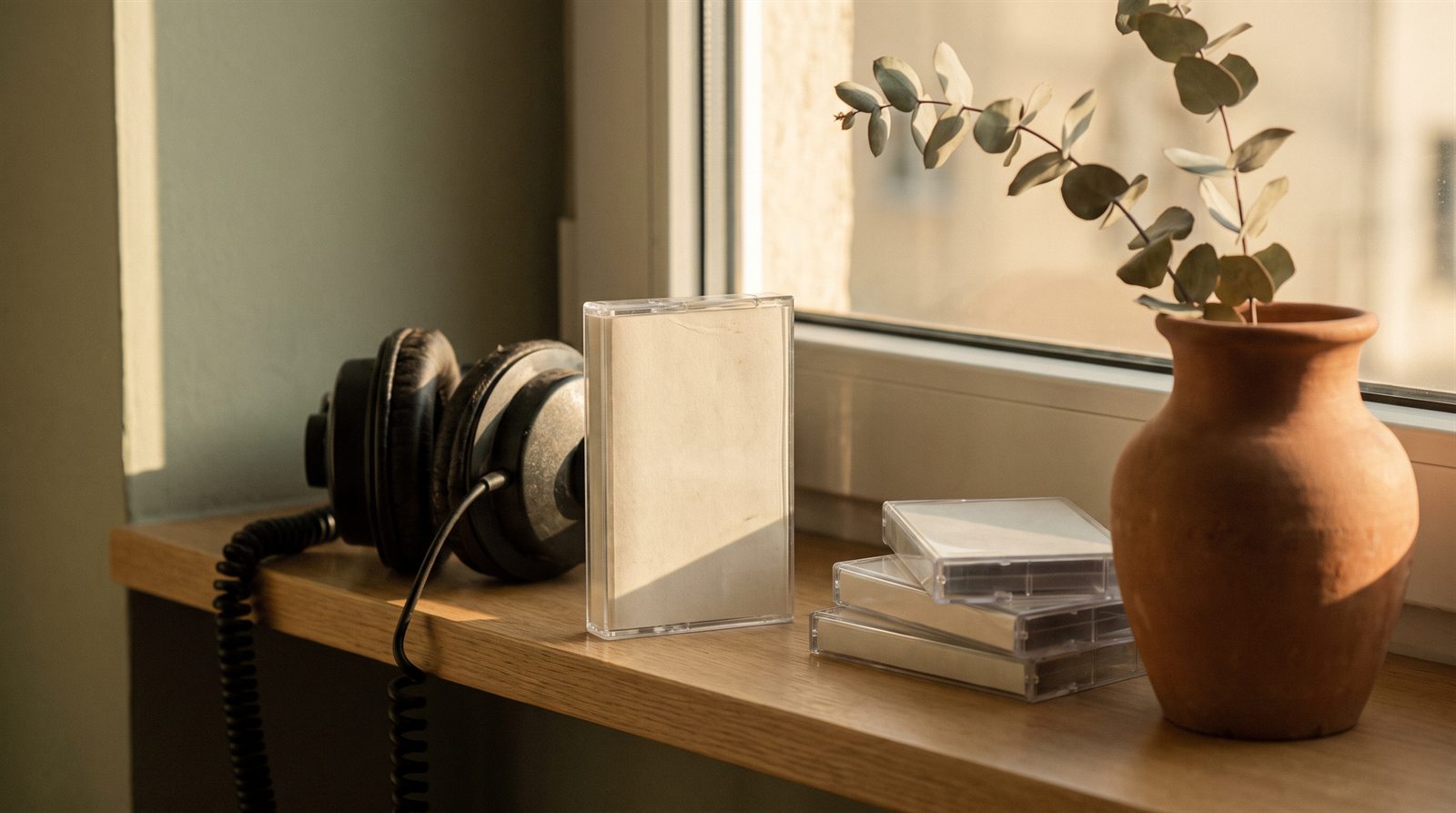
Some days I can feel the stress before I can name it.
My shoulders are up near my ears. My thoughts are three steps ahead of the conversation I am having. I have been worrying about tomorrow since this morning, and about yesterday since before that.
On those days, before I try anything clever, I put on a song.
Often it is something from the nineties, the music I grew up with. I don't have to think about it; I already know where every chorus goes. Somewhere in the second verse my breathing slows and my jaw lets go, and I notice I have been holding myself tight all day.
It doesn't fix the thing I am worried about. It gives me back enough of myself to face it.
So this piece is a mixtape. Side A is what is happening when music helps. Side B is what you can do with it. Press play.
Side A, track 1: What the research hears
I used to think this was just me being sentimental. It isn't only that.
In 2020, a team led by the Dutch researcher Martina de Witte brought together 104 randomised controlled trials of music interventions, involving more than 9,600 people [1]. Across those studies, music reduced stress: both in how stressed people said they felt and in what their bodies showed, such as heart rate, blood pressure and stress hormones [1]. The effect on how people felt was larger than the effect on their bodies, and among the body measures, heart rate changed the most [1].
Not a cure. But a real, measurable, gentle push in the right direction.
Side A, track 2: Why the old songs hold on
Have you noticed that the songs from when you were young land differently from anything new? There is a reason for that too.
Psychologists call it the reminiscence bump. Earlier research found that the music we meet in late adolescence and early adulthood has the greatest impact on our lives, and in a 2013 study at Cornell University, Carol Lynne Krumhansl and Justin Zupnick found that songs popular in our early twenties seem to have the greatest lasting emotional impact [2].
Their surprise finding was that the young people they studied also had strong memories and feelings for the music their parents loved when the parents were young [2]. The researchers called it cascading reminiscence bumps: songs passed down through a family, carrying memories with them [2].
So when a nineties song makes me feel steady, it isn't only the melody. It is every room I was standing in when I heard it, handed back to me in three or four minutes. Maybe one day my son will hum one of my songs without knowing why.
A familiar song is a small room you can step into when the world gets loud.
Side B, track 3: Make a calm list
A playlist costs nothing, stays private and fits in your pocket. Here is how I would build one for the hard days:
- Start with songs you already know by heart. Familiar music asks nothing of you.
- End on a few slower songs, so the list helps you come down instead of keeping you wound up.
- Keep a separate list for energy, for the mornings when you need to get moving.
- If a song pulls you further into sadness than you want to go, skip it. You are allowed.
- Keep the volume kind to your ears, especially with headphones.
Side B, track 4: One song, nothing else
You don't need an hour. Try this when the stress climbs.
Put on one song you love. Sit or lie down. For the length of that song, do nothing else: no scrolling, no planning, no answering messages. Notice your breathing. Notice where you are holding tension, and let one place soften. When the song ends, write one sentence about how you feel.
That last part is my own habit, too: music first, then the page. Together they do what neither does alone.
Side B, track 5: Send someone a song
Sometimes it is hard to say "I'm struggling." A song can say it first.
If you have a partner, or someone you trust, try sending them the song you have had on repeat, with one line:
"This is how today felt."
"This song helps me when my mind won't slow down. Can we listen to it together tonight?"
"I'm not good at explaining it. Maybe this explains it a little."
And to the person who receives it: listen to the whole song. Then ask, gently, which part of it felt like them. You may learn more in four minutes than in an hour of questions.
Hidden track
Music is not a replacement for care. If stress, low mood or anxiety is affecting your sleep, your health or your days, please talk to a doctor or a mental health professional, and keep the music as company along the way.
I still overthink. I still have nights when my mind runs ahead of me. But I have learned I don't have to sit in the silence with it. I can press play, let a song I have known for years fill the room, and come back down slowly, one verse at a time.
Liner notes
- [1] de Witte, M., Spruit, A., van Hooren, S., Moonen, X. & Stams, G.-J. (2020). "Effects of music interventions on stress-related outcomes: a systematic review and two meta-analyses." Health Psychology Review, 14(2), 294–324. doi.org/10.1080/17437199.2019.1627897
- [2] Association for Psychological Science (2013). "Young Adults Reminisce About Music From Before Their Time," on Krumhansl, C. L. & Zupnick, J. A., "Cascading reminiscence bumps in popular music," Psychological Science. psychologicalscience.org/news/releases/young-adults-reminisce-about-music-from-before-their-time.html
This article is for general awareness and reflection. It is not medical advice or a diagnosis. If stress or low mood is affecting your health or daily life, please talk to a doctor or a mental health professional. In a crisis, contact your local emergency services; the support contacts in Settings are there for you too.
Which song brings you back to yourself, and what does it remind you of?
Write as much or as little as you like. It stays private on this device.
Write your own