



When Worry Gets Loud: Anxiety in Your Teens, and How to Talk About It
For teenagers and the people who love them: what anxiety is, how it feels in your mind and body, what helps, and how to tell a parent or trusted adult that you are struggling.
By Janice F. · 6 min read
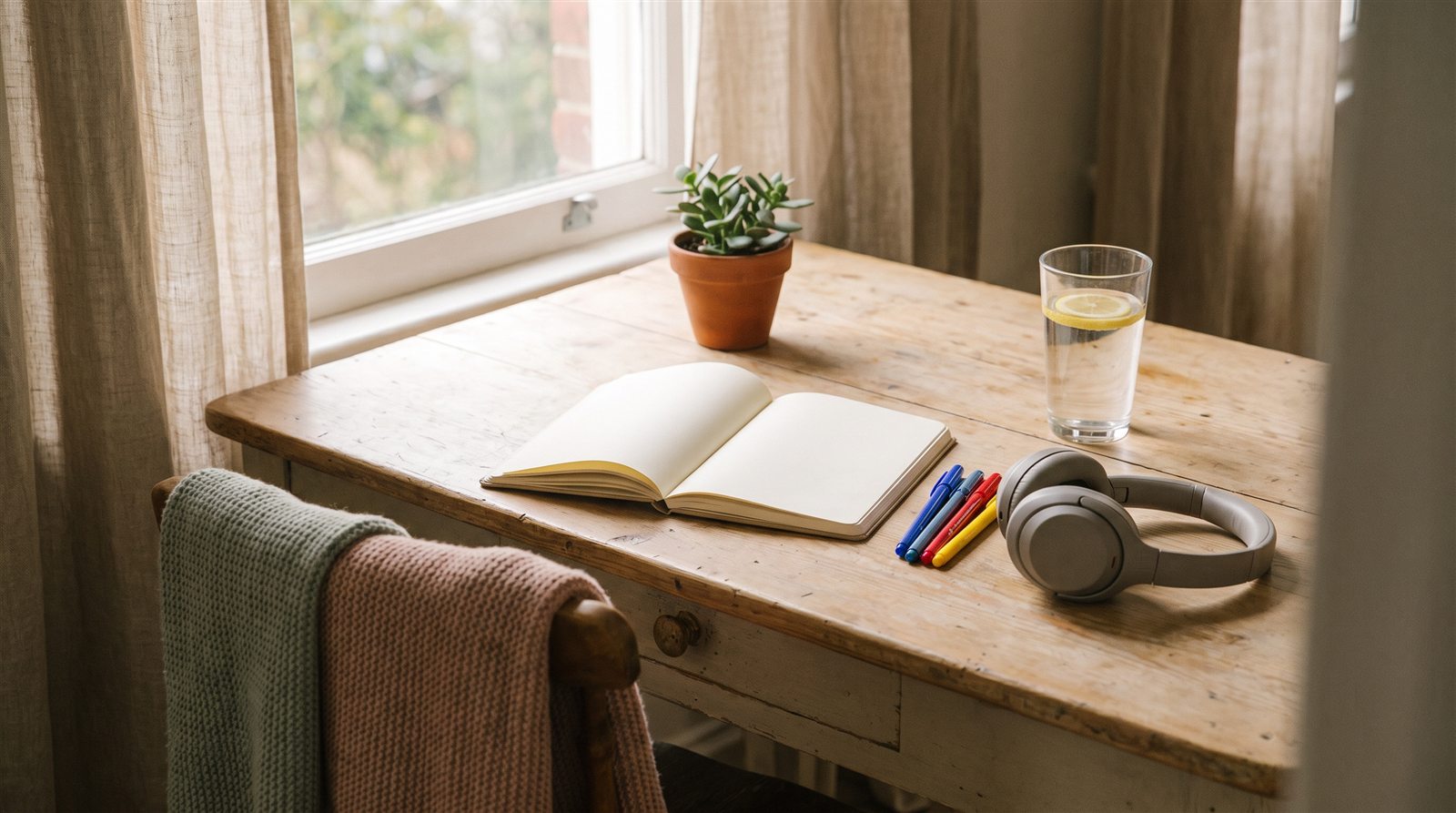
Dear you,
I don't know your name, but I think I know a little of how you feel.
Maybe your stomach hurts every morning before school. Maybe you lie awake replaying something you said, sure that everyone noticed. Maybe there's a voice in your head that whispers that something bad is about to happen, that you can't cope, that you're the only one who feels like this.
You're not the only one. Not even close.
Why I'm writing to you
I was in grade six when my family broke apart. I'm the eldest of three, and my youngest sister was only a baby. Overnight it felt like I had to be grown up, protective, strong. I didn't have words for everything I was carrying. Nobody told me it was okay to say, "This is too much for me."
So I'm telling you now.
"Is something wrong with me?"
No. Worry is part of being human. It's your body's alarm system, built to keep you safe. Anxiety is what happens when that alarm gets stuck on loud.
And you are far from alone. The World Health Organization estimates that one in seven people aged 10 to 19 around the world live with a mental health condition, and that many of them never get noticed or helped [1]. About 4% of 10 to 14 year olds and 5% of 15 to 19 year olds have an anxiety disorder [1].
Your teenage years are a lot: exams, friendships, family changes, phones that never go quiet, working out who you are. The WHO names bullying, harsh treatment, pressure from friends and figuring out your identity as real sources of stress [1]. Of course your alarm is loud. Look at everything it's trying to protect you from.
You are not too sensitive. You are carrying a lot, and your body is asking for help.
"How do I know if it's anxiety?"
It shows up in your thoughts and in your body. The NHS lists signs like these [2][3]:
- worry that's hard to control and gets in the way of your day
- feeling restless, tense or on edge
- being irritable, or having angry outbursts
- finding it hard to concentrate
- lots of negative thoughts, or feeling sure bad things will happen
- not feeling brave enough to try new things
- trouble sleeping, or bad dreams
- feeling tired all the time
- stomach aches, or changes in eating
- a pounding heart, or feeling dizzy
It's time to get help when the worry is very strong, keeps getting worse, or gets in the way of school, friends, sleep or eating [3].
"What if I have a panic attack at school?"
A panic attack can feel like your body has hit an emergency button: a racing heart, sweating, a wave of fear that something terrible is happening [4]. It's frightening. But here's what the NHS wants you to know: panic attacks usually last between 5 and 20 minutes, and they are not dangerous [4].
If one comes, stay where you are if you can, breathe slowly and deeply, and remind yourself it will pass [4]. Because it will.
A secret breathing trick
Nobody can tell you're doing this, so you can use it in class, on the bus, or in the bathroom before a test. It comes from the NHS [5]:
- Breathe in gently through your nose, letting the air sink down into your belly, counting slowly to 5.
- Breathe out gently through your mouth, counting to 5 again.
- Don't force it. If you can't reach 5 at first, that's okay.
- Keep going for at least five minutes.
Things that help more than you'd think
The WHO says good sleep, moving your body, learning to handle problems and feelings, and having supportive people at home, at school and around you all protect young people's mental health [1]. In real life, that might look like keeping regular times for sleep and meals [3], going for a walk or a dance in your room, muting the group chat that always makes you feel worse, breaking a scary task into tiny steps, or writing your worries on paper, where they're smaller than they are in your head.
"How do I even tell someone?"
This might be the hardest part. You might worry that your parents will be angry, or disappointed, or won't get it. Most adults who love you would much rather know, so they can help.
Here are some ways to start:
- Pick a calm moment. Car rides and walks are good, because you're side by side instead of face to face.
- Start small: "Can I talk to you about something? I've been really worried lately."
- Say what happens: "My stomach hurts every morning before school." "I can't sleep because my mind won't stop."
- Say what you need: "I don't need you to fix it. I just want you to know." Or: "Can you help me talk to a doctor?"
- If saying it out loud is too hard, write it in a note or a message, or show them this letter.
- If a parent isn't the right person, choose another adult you trust: a teacher, a school counsellor, an aunt, a coach, your family doctor.
If you ever feel unsafe, or think about hurting yourself, tell an adult straight away, or contact your local emergency services or a crisis line. You deserve help right now, not later.
One last thing
You are not too much. Your feelings are not a burden. Anxiety can get better with the right support, and the bravest step is usually a small one: telling one person.
I'm proud of you for reading this far.
With love, Janice
P.S. For the grown-ups reading over their shoulder
The NHS has some advice for you [3]. Talk to them about their worries, and listen carefully to understand how they feel. Don't dismiss what they say or jump to conclusions. Help them find their own solutions rather than solving everything for them. Keep daily routines steady. Don't push them into stressful situations without talking first, but try not to become overprotective or anxious yourself. If the anxiety is severe, lasting or affecting their daily life, see a doctor together and talk to their school.
Above all, stay calm and stay close. A teenager who knows they can bring you anything is a teenager who is far less alone.
Sources
- [1] World Health Organization. "Mental health of adolescents" fact sheet. who.int/news-room/fact-sheets/detail/adolescent-mental-health
- [2] NHS. "Symptoms of generalised anxiety disorder (GAD)." nhs.uk/mental-health/conditions/generalised-anxiety-disorder/symptoms
- [3] NHS. "Anxiety in children." nhs.uk/mental-health/children-and-young-adults/advice-for-parents/anxiety-in-children
- [4] NHS. "Panic disorder." nhs.uk/mental-health/conditions/panic-disorder
- [5] NHS. "Breathing exercises for stress." nhs.uk/mental-health/self-help/guides-tools-and-activities/breathing-exercises-for-stress
This article is for general awareness and reflection. It is not medical advice or a diagnosis. If you are worried about anxiety, please talk to a doctor, school nurse or counsellor. In a crisis, contact your local emergency services; the support contacts in Settings are there for you too.
Who is one person you could tell, even a little, about what has been worrying you?
Write as much or as little as you like. It stays private on this device.
Write your own